
A new international literary project will allow researchers to access previously hard-to-find literature in many African languages, including Afrikaaps.
This is according to Prof Ashleigh Harris, the primary investigator of The African Literary Metadata (ALMEDA) project and a lecturer at Uppsala University in Sweden.
Most African literature, including Afrikaaps literature, circulates informally and is short-lived because it does not enter archives or databases, and the ALMEDA project sets out to correct this, according to Harris.
Stellenbosch University (SU) professor Dr Riaan Oppelt, one of the sub-investigators for the ALMEDA project, is the main driver of its Afrikaaps subdivision.

Dr Riaan Oppelt is a professor in English and cultural studies from Stellenbosch University and the Afrikaaps sub-investigator for the African Literary Metadata (ALMEDA) project. According to Oppelt, he is not a researcher, but rather a “collector” of Afrikaaps literary works for the ALMEDA project. PHOTO: Daniélle Schaafsma
Proper recognition for Afrikaaps
Afrikaaps is a language that has been unstructured, unstandardised, and often looked at as a less proper version of Afrikaans, according to Oppelt.
Including Afrikaaps in a project such as ALMEDA is important because Afrikaaps is an actual language, said Oppelt, and “deserves all the kind of recognition and research that [another] language — where it’s not merely a vernacular — [receives]”.
It is important to create a system for Afrikaaps because “so many people want to be heard and represented, [and currently] there is an absence of Afrikaaps knowledge,” said Tamlyn Lewies, an Afrikaaps poet and a fourth-year BMus student at SU. “It is very important because representation [of Afrikaaps] is everything.”
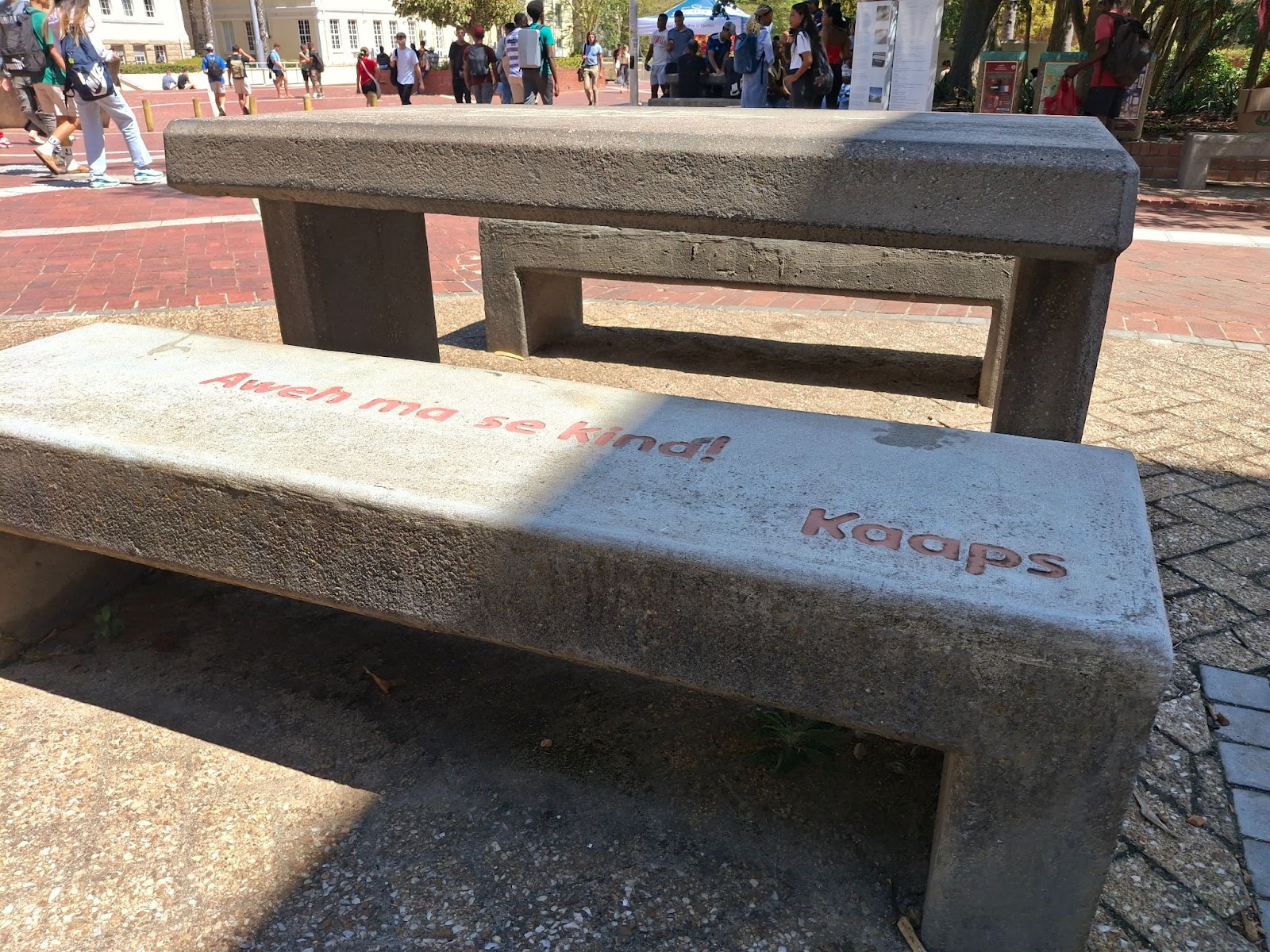
A bench on the Stellenbosch University (SU) campus depicts an Afrikaaps phrase, “Aweh ma se kind!”
Dr Riaan Oppelt, a professor in English and cultural studies at SU, and the Afrikaaps sub-investigator for the African Literary Metadata (ALMEDA) project, told SMF News that in a number of presentations he has done in Norway and Sweden, he would start the class by introducing people to the greeting, “Aweh ma se kinners”. PHOTO: Daniélle Schaafsma
The project’s plans
“When it comes to a text written in Afrikaaps or even a YouTube video of somebody performing a poem in Afrikaaps, it gets categorised […] intellectually, culturally, and socially as Afrikaans,” said Dr. Oppelt. “This makes it nearly impossible to locate Afrikaaps works [online].”
The project database will include traditional literature, as well as everything from novels, serialised in the 1960s in Tanzanian and Kenyan newspapers, to Afrikaaps rap music, according to Harris.
“Thus far, this kind of literature remains invisible to big data, and that impacts on its longevity as part of a cultural record,” said Harris.
Harris also said that the project hopes to make more works visible and searchable to researchers and the public alike.
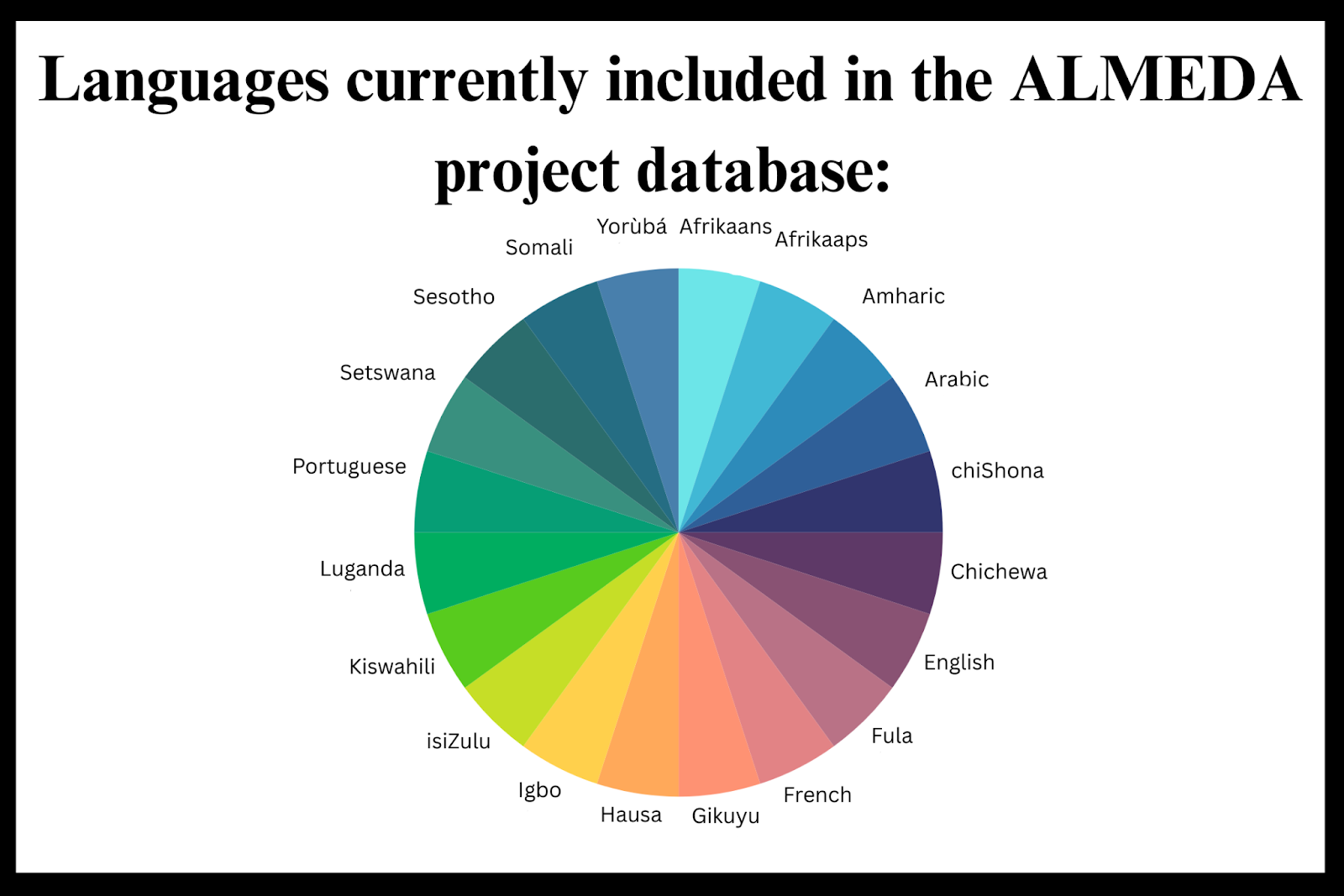
The African Literary Metadata (ALMEDA) project’s database will eventually be open to works in any of the approximately 2 755 African languages used on the continent, said Professor Ashleigh Harris, the primary investigator of the ALMEDA project and a lecturer at Uppsala University in Sweden. For now, however, the project has started out by modeling the database for 20 languages, she said. INFOGRAPHIC: Daniélle Schaafsma
Researchers like Oppelt collect elusive information and works, and upload and link them to existing data and to the ALMEDA repository, which will be live and open to the public in 2026, said Harris.
The database will be open for anyone to find works, upload new data, and correct existing data, according to Harris. However, she added that to ensure quality and accuracy of the data, the database will be monitored and checked by a team of experts.